A cat toy can look perfect when it comes out of the package, then change quickly once your cat starts biting, pulling, kicking, and chewing. A fuzzy toy may shed loose fibers. A moving toy can lose a tail within the first play session. A wand can develop a sharp break or a clasp that catches where it should not. Even a laser pointer can become warm, smell unusual, or stop working within seconds.
The same pattern shows up across these examples: how a toy looks on day one doesn't always tell you how it will hold up during real play. Some toys also create concerns that are easy to miss before use, such as mold, insects, or damaged plant material inside the package.
The better approach is simple. Check the parts your cat can pull, bite, swallow, or catch before you let play begin. Choose toys that stay together, feel sound in your hands, and give your cat a useful activity without adding avoidable problems.
DEFECT AUDIT OVERVIEW
| Product Area | Common Problems | Why It Matters |
|---|---|---|
| Plush and moving toys | Loose fibers, torn attachments, detached pieces | Small pieces can end up in a cat's mouth after chewing or tearing |
| Wands and laser pointers | Splintered rods, catching clasps, unusual heat or odors | Broken or poorly designed parts can create injury concerns during active play |
| Plant-filled and puzzle toys | Mold, insects, damaged fillers, food residue | Clean materials and manageable play challenges matter for safe, useful enrichment |
Can Loose Plush Fibers Cause Choking and Hairball Blockages in Cats?
A fuzzy cat toy can look harmless until your cat starts biting, licking, and pulling the plush apart. That's when a soft-looking covering can turn into loose material in the mouth, especially for cats that chew their toys instead of merely batting them around.
One reported case tied to PGH-AUDIT-G4DV describes material becoming lodged in the cat's throat and being removed with tweezers. Other feedback describes choking immediately after chewing the toy, along with furball-like material forming in the throat.
But the bigger issue is what happens before you even notice the toy is coming apart. A cat can shred a fuzzy surface into small pieces during ordinary play, then swallow some while grooming or chewing, leaving the owner to discover the problem only after the cat starts coughing, gagging, or struggling to clear its mouth.
🧵 Tug the Fuzzy Surface Before Your Cat Does
Take the toy in your hand and gently pull at several fuzzy areas, especially seams, corners, and places your cat has already bitten. If fibers or clumps come away with very little effort, treat that as a warning sign rather than assuming your cat will simply spit them out.
The safety benchmark supplied for this section puts particular emphasis on keeping small pieces from becoming easy-to-swallow fragments and on having the plush covering hold together rather than shed freely. In plain English, the fuzz should stay attached when a cat grabs, bites, and kicks it—not become a snack-sized pile of fluff.
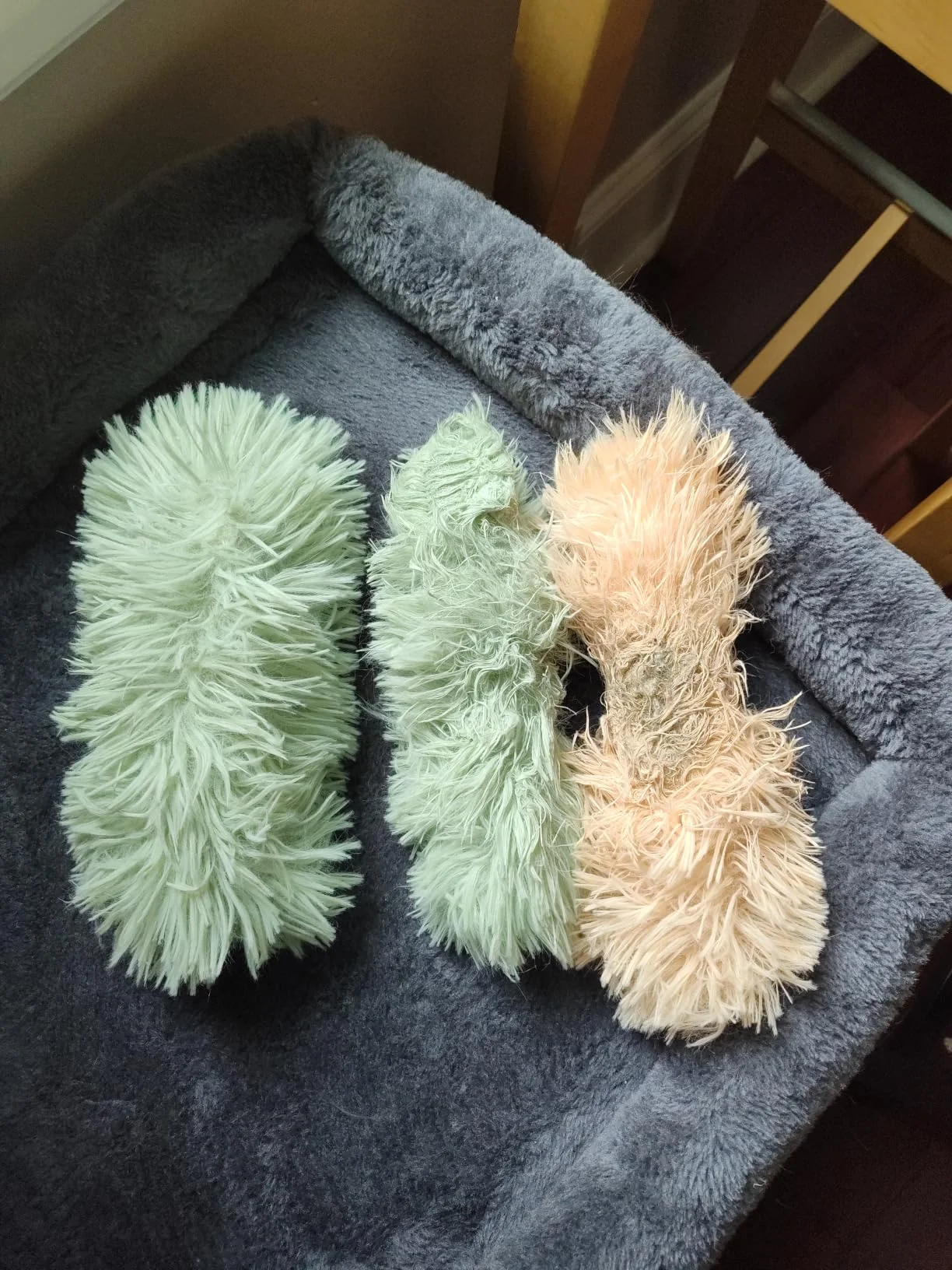
That distinction matters because the reported problem was not simply cosmetic shedding. The observed case involved material being pulled from the cat's throat, while other feedback specifically connected the fuzzy covering with furball formation and possible blockage.
The practical takeaway is simple: a plush cat toy should survive your fingers before you expect it to survive your cat's teeth. If the surface starts coming loose during a gentle pull, there is little reason to assume vigorous chewing will be kinder to it.
For cats that routinely bite and tear toys, this particular type of plush design deserves extra caution. The current feedback does not mean every fuzzy cat toy will cause a choking problem, but this product experience shows why loose fibers are worth checking before play, rather than waiting for the cat to tell you something went wrong.
What Happens When Moving Parts on Interactive Cat Toys Break Within Hours?
A moving cat toy is supposed to turn a few minutes of play into a chase, not turn into a pile of loose parts on the floor. Yet when a cat bites, kicks, and yanks at a toy, a weak attachment can fail surprisingly fast, leaving pieces behind exactly where the cat is still playing.
Two reported examples, PGH-AUDIT-5KHM and PGH-AUDIT-S14, describe mechanical failure within about 30 minutes of use. In the same feedback, tail pieces were reportedly torn off within two hours, turning what looked like an interactive toy into something that needed to be picked up before the cat kept chewing it.
That's the part worth paying attention to: the clock matters. A toy that survives a few gentle movements in your hand may behave very differently once a cat repeatedly bites and pulls the same attachment.
🐾 Pull the Attachments Before Your Cat Does
Hold the toy firmly and give each moving attachment a gentle tug, particularly the tail, ears, tabs, or other pieces your cat is likely to grab. If a part shifts, stretches, separates, or makes the stitching look ready to open, put it aside rather than waiting for play to finish the job.
The supplied safety benchmark gives a simple reason for taking that check seriously: the toy's seams are expected to tolerate repeated pulling rather than separating after a handful of hard grabs. The benchmark specifies at least 150 N of pull force at the seams and at least 50 repeated pulls at 10 N.
In everyday terms, the goal is not to make your cat perform a laboratory experiment. It is to avoid buying a toy where the first energetic play session effectively becomes the durability test.
The reported failures make that concern concrete. One set of feedback describes the toy breaking in under 30 minutes, while another reports both tails being ripped away within two hours. Once those pieces are detached, the risk changes from "the toy stopped working" to "there are now loose pieces where a cat can bite them."
So when evaluating interactive cat toys, don't focus only on how cleverly they move out of the box. Look at what your cat can physically tear off. If an attachment cannot handle a modest hand pull before purchase, its advertised interactivity may not mean much once claws and teeth enter the picture.
The current reports do not establish that every moving toy will fail this way, but these particular examples make early attachment checks worthwhile. A toy that falls apart within the first play session is difficult to treat as a reliable long-term enrichment option.
How Wand Rod Materials and Metal Clasp Designs Can Injure Cat Paws
A cat wand can look like a simple piece of play gear until the rod cracks or the clasp catches somewhere it should not. Then the same toy meant for chasing can leave sharp fragments in a hand or a metal hook wedged into a cat's paw.
One reported case linked to PGH-AUDIT-GGPT describes a fiberglass rod breaking into splinters that ended up in the user's hand. The same product feedback describes a carabiner-style hook becoming deeply lodged between a cat's toes and nail bed, with pliers needed to remove it and bleeding reported during the incident.
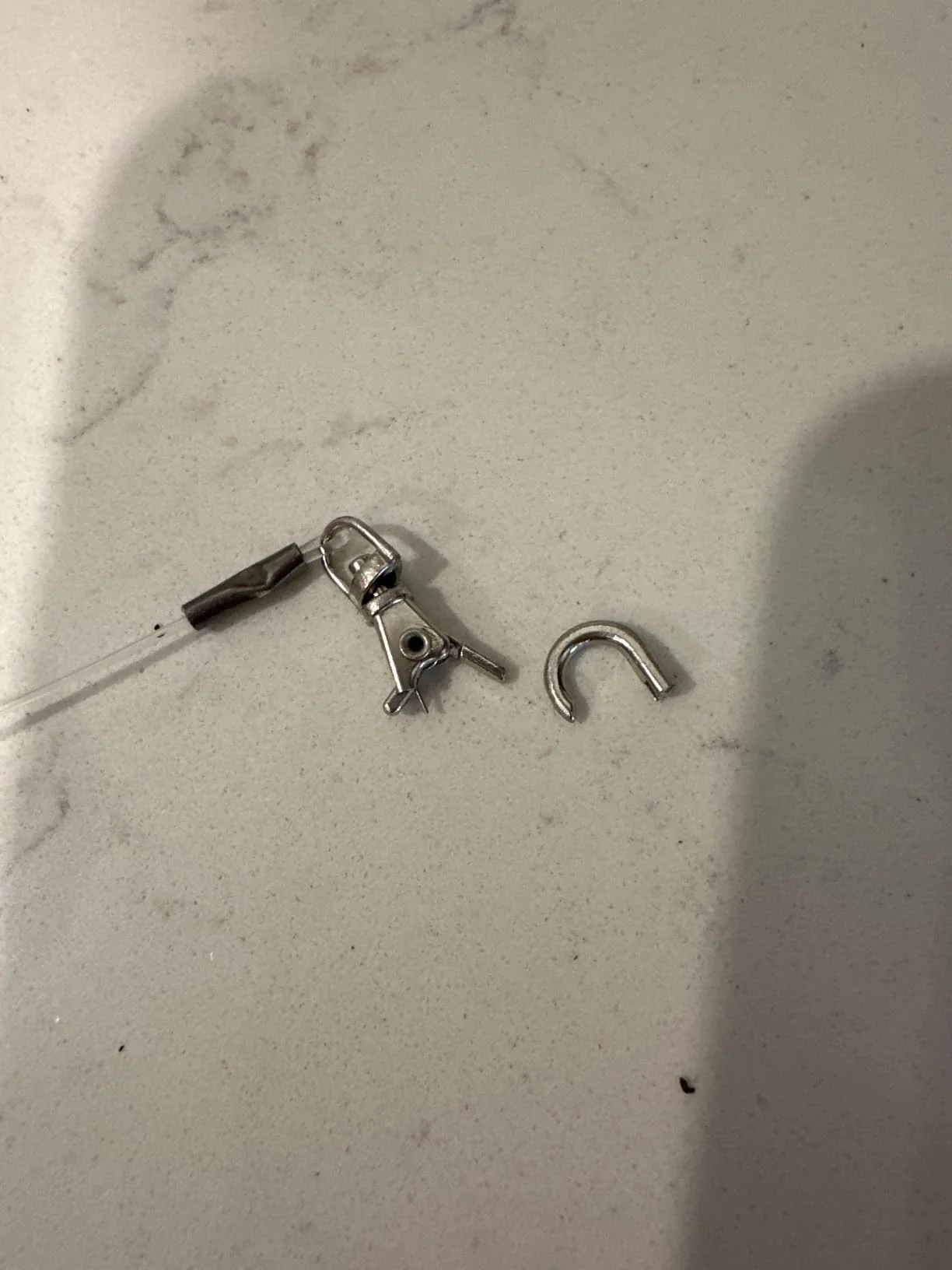
That's a particularly ugly failure because the cat does not need to chew the clasp for it to become a problem. During a fast chase, a dangling attachment can catch between toes, around furniture, or against another part of the toy, turning a few seconds of play into a struggle to get free.
🖐️ Feel the Rod and Open the Clasp First
Before handing the wand to your cat, run your fingers along the entire rod and inspect the metal attachment. Look for cracks, rough spots, exposed strands, sharp edges, or a hook shape that could catch skin or slip between toes.
Then gently work the clasp with your fingers. If it has a sharp exposed point, feels rough when you close it, or leaves a gap where a toe could become trapped, that's a poor feature to discover only after the cat starts sprinting.
The supplied guidance also flags long loose lines as a concern, with the stated limit at 18 cm, because a cat can bite, swallow, or become caught in loose material. The product feedback adds another practical warning: the same wand set reportedly had a line thin enough for a cat to bite through within minutes, while other attachments fell apart after very little use.
The safest takeaway is not that every metal clasp or rigid wand is automatically unsafe. It is that the parts closest to your cat's paws deserve the same scrutiny as the toy itself.
A wand that feels cheap, splintery, or awkwardly hooked in your hand can become much harder to deal with once a moving cat is attached to the other end. In this reported case, the combination of a breaking rod and a catching clasp created two separate injury points, so a little inspection before play is worth the few seconds it takes.
Signs of Overheating, Chemical Odors, and Rapid Failure in Cat Laser Pointers
A laser pointer should produce a clean, predictable light—not become warm, smell strange, and quit after a few seconds. One reported case involving PGH-AUDIT-B4FM described the laser working for less than 20 seconds before failing permanently, with abnormal warmth and a chemical-like odor appearing during use.
The same feedback also described the advertised red laser being replaced in practice by a weak, diffuse light. That combination matters because a pointer that already behaves strangely during a short session is not something to keep running just to see whether it eventually recovers.
👃 Smell the Housing While It Is Still Cool
Before using a laser pointer around your cat, switch it on briefly yourself and pay attention to the housing. If you notice an unusual chemical smell, abnormal warming, buzzing, or a sudden change in the light, stop using it rather than repeatedly pressing the button.
You can also compare the beam with what the product promises. The reported unit was advertised as a multi-mode laser pointer but produced only a diffuse flashlight-like output, with some users reporting failure after one use or less than 20 seconds.
There's another issue that has nothing to do with the casing: the cat never gets to catch a laser dot. The supplied behavioral guidance specifically warns against relying on a laser pointer alone, because endless chasing without a physical object to capture can create frustration rather than a satisfying end to the play sequence.
That does not mean every laser session will cause a behavioral problem. It does mean the light should not be treated as the entire game. Ending with something your cat can actually catch and bite gives the chase a physical finish instead of leaving the target permanently out of reach.
For the electrical side, an odd smell or unexpected heat is enough reason to retire a questionable unit. A cat toy that smells wrong, heats up, and fails almost immediately has already given you useful information. The current reports point to a particular product experience rather than proving every laser pointer has the same defect, so cautious owners should judge the actual unit in front of them rather than trusting the marketing label.
Digestive Risks of Mold, Live Pests, and Unregulated Plant Fillers in Cat Toys
A cat toy can look perfectly ordinary on the shelf and still have a very different story once the package is opened. One reported case involving PGH-AUDIT-D1V6 described live insects inside sealed packaging, visible mold on a rope, and a foul odor that appeared before the toy was even put into use.
The problem became more serious when the cat chewed the plant-based material. The reported dried gall fruit was associated with refusal of food and water, severe illness, and substantial veterinary costs, despite the product being presented as non-toxic.
But the packaging itself can give you an early warning.
👀 Open the Package and Look Before Play
Open a new toy somewhere with good light and look closely at the knots, seams, plant pieces, and inner surfaces. If you see insects, dark mold-like spots, moisture damage, or anything that smells foul, keep the toy away from your cat instead of assuming the odor will disappear.
In the reported case, the package had reportedly remained unopened for weeks before live insects were discovered inside. Another part of the same product showed visible mold and an unpleasant smell, while a catnip compartment had ruptured and spread its contents onto the surrounding material.
That makes this more than a question of whether your cat likes the toy. Anything your cat is expected to chew should at least arrive looking and smelling like something you would willingly put near its mouth. A sealed package is not proof that the contents stayed clean during storage.
The supplied guidance also calls for chewable materials to be kept clean and for toys to be cleaned regularly, with a 24–48 hour refresh window for olfactory enrichment. That is especially relevant when a toy contains plant material or food-like fillers that can collect moisture and residue.
Most importantly, the reported illness should be treated as a product-specific experience rather than proof that every plant-filled cat toy will cause digestive problems. Still, live pests, visible mold, a foul odor, or unexplained plant material are reasonable reasons to stop before the first bite. Once a cat has started chewing, you no longer have the luxury of inspecting the material before exposure.
How Puzzle Feeders and Cognitive Play Help Reduce Boredom Behaviors
Cats do not need every toy to make noise, flash, or roll across the floor. Puzzle feeders give them something to figure out, turning a simple reward into a small sequence of pawing, nudging, searching, and getting the food out.
That matters for cats that seem bored despite having plenty of toys. A pile of objects can provide stimulation, but a puzzle toy adds a reason to interact: find the reward, work out how to reach it, then get the payoff.
Research cited for this section gives that idea some measurable weight. Buffington et al. (2016) reported that cats using food puzzles showed 42% fewer stereotypic behaviors compared with free-fed controls, while also showing higher engagement and better problem-solving performance over the study period.
The benefit is not simply that the cat stays busy for a few extra minutes. Puzzle play changes what the cat has to do with its attention. Instead of immediately receiving food from a bowl, the cat has to interact with the environment and complete a small task before the reward appears.
Cognitive enrichment can also extend beyond feeding. Gourkow and Phillips (2016) found that shelter cats receiving daily cognitive enrichment showed a 2.1-fold increase in mucosal IgA, alongside a substantial reduction in stereotypic behaviors.
For kittens and indoor cats, that makes cat puzzle toys particularly useful when ordinary play is no longer holding attention. The goal is not to make the toy frustratingly difficult; it is to create a manageable challenge where the cat can investigate, succeed, and repeat the behavior.
A practical starting point is short sessions rather than leaving one complicated feeder out indefinitely. The supplied guidance recommends roughly 10–15 minutes of active puzzle engagement per session, with regular cleaning so food residue does not become a hygiene problem.
In other words, the best boredom solution is not necessarily the toy with the most moving parts. Sometimes it is the one that gives the cat a small problem worth solving.
CONCLUSION
The strongest lesson from these toy examples is that a quick hands-on check can reveal problems that packaging cannot. Pull gently on fuzzy surfaces and moving parts. Feel a wand for cracks or rough areas. Check clasps for shapes that could catch a paw. Run a questionable laser briefly yourself and stop if it becomes unusually warm, smells strange, or behaves differently from what was promised. Open plant-filled toys in good light and look for mold, insects, moisture damage, or foul odors before your cat gets close.
For cats that chew and tear, durability matters even more because a toy can quickly change from an enrichment item into loose material on the floor. At the same time, not every problem means an entire type of toy should be avoided. Puzzle feeders, for example, can provide useful mental activity when the challenge is manageable and the toy is kept clean.
A careful buyer should judge the actual toy, not just its appearance or marketing. If a part already feels weak before play starts, there is little reason to expect it to improve once your cat gets involved.
THE ULTIMATE BUYING VERDICT
| Verdict | Key Consideration | Recommendation |
|---|---|---|
| 🔴 Significant concerns | Toys with loose plush fibers, weak attachments, splintering rods, catching clasps, unusual heat or odors, mold, insects, or damaged plant material have meaningful concerns in the supplied examples. | Do not give a questionable toy to your cat. Set it aside when parts pull loose, the material looks damaged, or the toy behaves strangely before or during use. |
| 🟡 Acceptable with limitations | Laser pointers can provide chase play but do not give the cat a physical object to catch, while puzzle toys need a manageable challenge and regular cleaning. | Use these toys thoughtfully. Keep laser play from being the entire activity, offer a physical finish, and keep puzzle toys clean and easy enough for the cat to succeed. |
| 🟢 Meets long-term expectations | Toys that keep their parts attached, have sound surfaces and attachments, arrive clean and intact, and provide engaging activities without obvious material problems are the more desirable choice. | Look for sturdy construction, secure attachments, clean materials, and play that gives your cat a safe, repeatable way to investigate, chase, chew, or solve a small problem. |