
A ramp or set of pet stairs can seem like an easy way to help an older dog reach a bed, couch, or vehicle. But small design details can change how secure the climb feels. A ramp that is too steep can make each step harder. A stair with a soft or sagging center may feel different under the dog's weight. A shallow top step can leave little room to turn around, while poor grip can let the entire unit slide across hardwood or tile.
These problems are easy to miss in product photos. The cover may look soft and comfortable while the support underneath is weak, or a staircase may appear stable until a dog actually climbs onto it. For senior or mobility-limited dogs, the useful question is not simply whether stairs or a ramp are included. It is whether the setup stays predictable from the first step to the last.
How Steep Ramp Incline Angles Strain Joints in Senior Dogs
A ramp can look like the kinder alternative to jumping, but the angle changes the whole experience. When a senior dog has arthritis, hip trouble, or IVDD, a steep climb can turn a supposedly gentle walk into a much harder effort.
One reported case involved a 15-year-old Cane Corso that struggled with steep, narrow steps while needing dependable access to a vehicle. Another case involved a Frenchie recovering from IVDD that needed stable support rather than a setup that made every step feel uncertain.
That is where the slope deserves more attention than the marketing photo. The supplied evidence identifies 10° or less as the preferred upper range, while inclines above 15° are associated with greater slipping and joint-strain concerns.
The difference is simple to picture: on a gentler ramp, the dog can keep walking upward. As the ramp gets steeper, the dog has to lift the body more sharply with each step, leaving less room for an older dog to move comfortably.
For a product with the anonymized case record PGH-AUDIT-D6ZB, that matters because the reported problem was not merely that the steps looked small. The top step was reported at only about four inches deep, compared with roughly seven inches on the others, while the unit could also wobble under larger dogs.
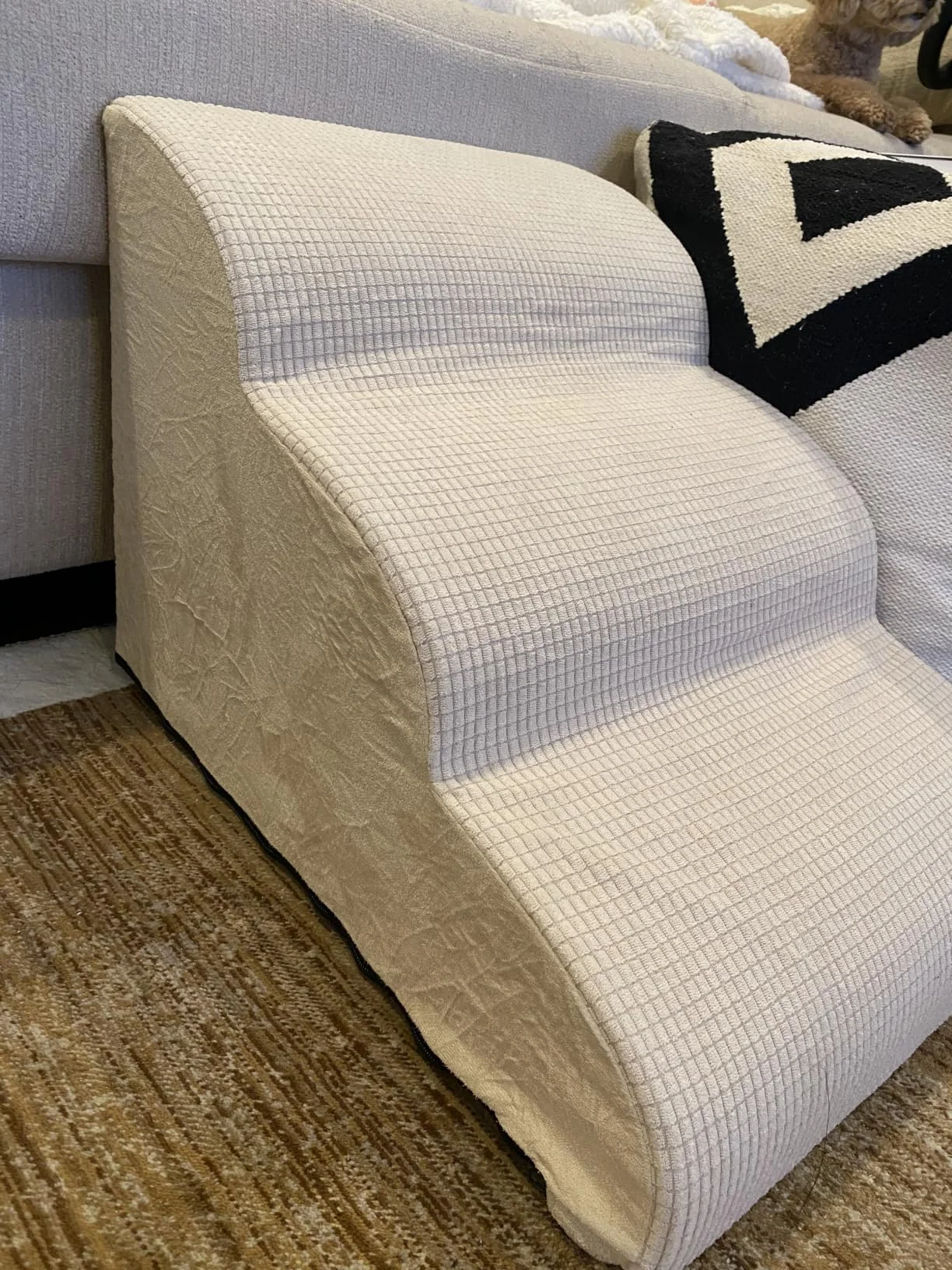
🐾 Stand Beside the Ramp and Watch One Climb
Before trusting the setup, watch your dog make one slow trip upward. Look for hesitation, unusually high stepping, stopping halfway, or an immediate turn back. Don't assume that a soft surface automatically makes a steep incline comfortable.
The available research gives this visual check some useful context. Carr et al. (2013) compared dogs moving up ramps and stairs and found that ramps allowed smoother movement of the legs with less strain than stairs. The supplied evidence also cites Lenker et al. (2016), where slopes at or below 10° were identified as more accessible for mobility-aid users.
A useful practical detail follows from that angle: if the height difference is around 12 inches, maintaining a 10° slope requires roughly six feet of ramp length. A short ramp may look convenient beside the bed or car, but convenience for the owner can become extra work for the dog.
The second anonymized record, PGH-AUDIT-98V6, also flags steep steps as a problem for pets with mobility difficulties.
For older or mobility-limited dogs, a ramp is not simply about having fewer steps. The incline itself is part of the safety equation, and the current evidence makes a gentler slope the more defensible target.
What Happens When Internal Plastic Supports Sag Under Medium Dogs
A soft cover can make a set of pet stairs look reassuringly sturdy. The real question is what happens underneath when a medium-sized dog puts its weight on the middle.
In one reported case, the internal corrugated support did not fit the intended pocket correctly, leaving the structure sagging and sinking under weight. That is a very different problem from a cover that simply looks wrinkled: the dog may feel the surface give way underneath its paws.
The case associated with PGH-AUDIT-D6ZB is especially telling because the reported insert was oversized or poorly fitted inside its pocket. Instead of keeping the steps firm, the support could contribute to an uneven, depressed surface when loaded.
This can create an unpleasant surprise for a dog that expects the next step to stay where it was a second ago. A sudden dip can make an older or cautious dog hesitate, scramble for balance, or abandon the stairs altogether.
The second reported example, PGH-AUDIT-98V6, also involved a pet stair design where the foam failed to provide the expected firmness and the structure could become unstable under heavier use.
🖐️ Press the Middle Before Your Dog Does
Put your hand firmly on the center of each step and push down several times. Look for a noticeable hollow spot, delayed rebound, or a step that feels dramatically softer than the others.
If one section sinks while the neighboring sections stay firm, that uneven feel matters more than how attractive the outer fabric looks. A pet does not care whether the stairs photograph beautifully; it needs each step to feel predictable under its paws.
For buyers comparing designs, a rigid internal support that stays properly seated is worth more attention than decorative upholstery alone. The reported failures here suggest that when the support underneath is poorly fitted or prone to sagging, the soft exterior can hide a potential weak point until the dog is already standing on it.
The current reports do not establish that every corrugated-plastic insert will fail this way. They do, however, give buyers a concrete reason to check what is actually supporting the steps before trusting them with a medium or larger dog.
Why Step Top-Surface Depth Matters for Dogs Returning Downstairs
A set of pet stairs can have the right overall height and still create a bad landing at the very top. The top step is where your dog needs enough room to place a paw, shift its weight, and turn around without searching for empty space.
One reported example found the top step was only about 4 inches deep, while the remaining steps were closer to 7 inches. The same product was reported as difficult for larger or arthritic dogs, with the narrow upper surface leaving less room for a secure footing.
That becomes particularly awkward when a dog reaches the bed, turns around, and starts back down. A cramped top surface gives the dog less room to reposition before committing its weight to the next step. One misplaced paw can turn an ordinary trip downstairs into a scramble.
The problem is easy to miss because the stairs may look perfectly substantial from the side. A few inches of missing depth are much harder to notice in a product photo than a torn cover or broken zipper.
👀 Turn Around on the Top Step Yourself
Stand beside the stairs and look directly at the uppermost tread. Measure its usable front-to-back depth rather than measuring the entire frame, then compare it with the steps underneath.
If the top surface is dramatically shorter than the rest, treat that mismatch as a buying concern, especially for a large, senior, or mobility-limited dog. The reported example had a top step around 4 inches deep versus roughly 7 inches elsewhere, so the difference was not merely cosmetic.
There is no supplied evidence establishing 8 inches as a universal veterinary safety minimum, so that number is better treated as a conservative purchasing preference rather than a proven cutoff. What the available reports do support is simpler: a top step that is noticeably shallower than the others deserves scrutiny before you trust it with a dog that needs stable footing.
For senior dogs, the safest-looking staircase is not necessarily the one with the softest cover. Sometimes the critical detail is hiding under your dog's paws.
Pet Stairs Slipping on Hardwood: Fixing Bottom Grip Problems
A set of pet stairs can feel perfectly solid under your hand and still move backward the moment a dog launches onto it. On hardwood or tile, that is the failure point worth watching: the entire staircase moves instead of staying planted while the dog is climbing.
One reported case involved stairs that repeatedly slid on hardwood, while another reported product had instability under medium and larger dogs. The same group of reports includes pets refusing stairs because they felt unstable, which turns an access aid into something the dog simply avoids.
For a senior dog, that hesitation is not trivial. A dog approaching furniture may already be compensating for sore hips, weak legs, or an uneven gait. If the stairs suddenly shift backward when the front paws land, the dog has to recover balance while still moving upward.
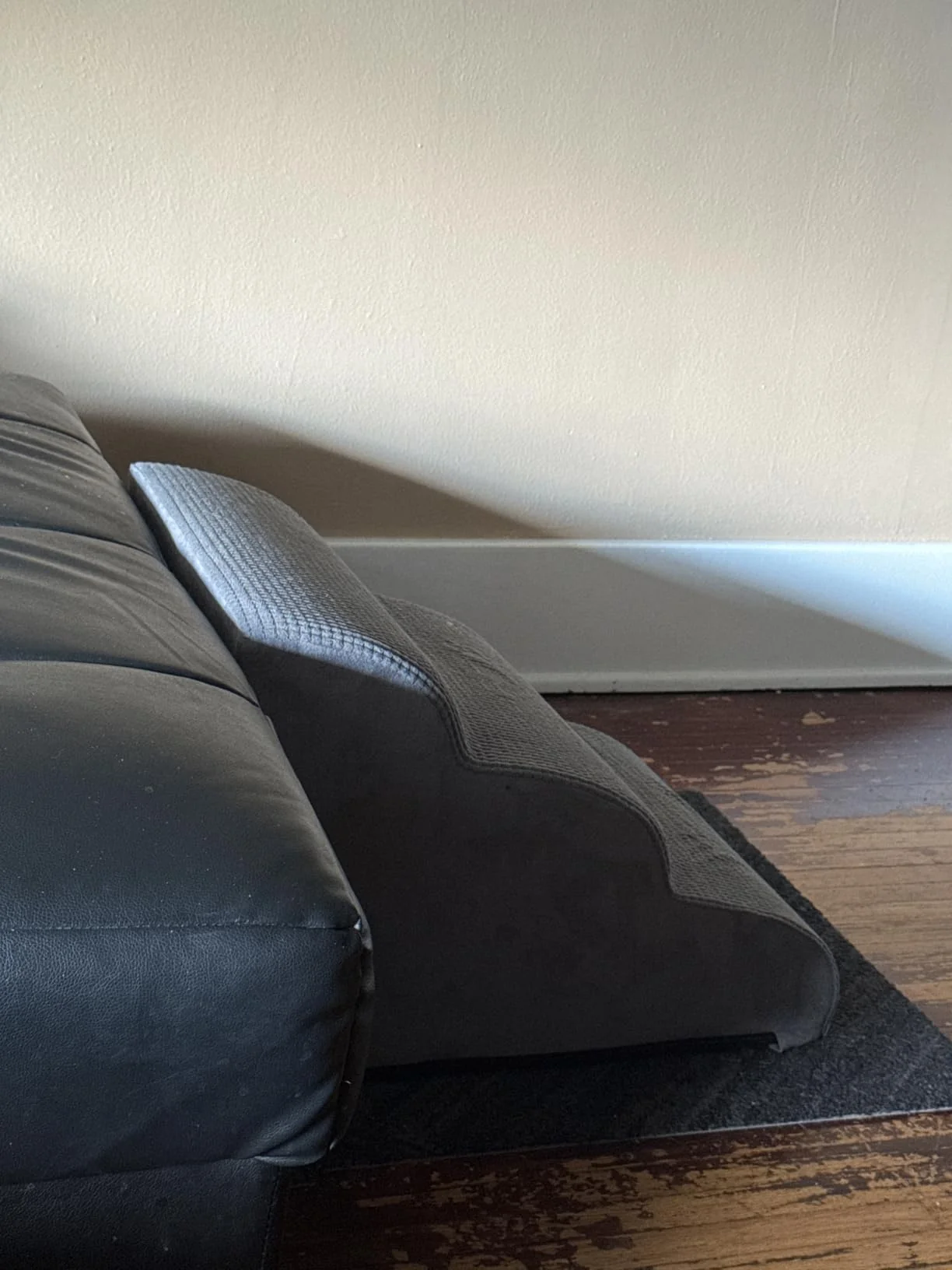
This is where the supposedly helpful staircase can become the awkward part of the journey. The dog is expecting the step to stay put; instead, the step moves underneath it.
The case associated with PGH-AUDIT-98V6 also documents ineffective grip on hardwood and tile, with the stairs sliding rather than remaining stable.
🧱 Push the Bottom Before Your Dog Climbs
Place the stairs on the exact floor where they will be used. Hold the top firmly, then push the base forward and backward with your foot or hand.
If the whole unit creeps across the floor with moderate pressure, do not treat the bottom as "non-slip" simply because it has rubbery dots or textured material. What matters is whether the staircase actually stays in place when force is applied.
The supplied orthopedic-recovery evidence adds another reason to take unexpected movement seriously. Dorn (2017) discusses recovery-area design for dogs after orthopedic procedures and notes the risk of jumping from elevated resting areas, particularly when the setup encourages movements that can lead to re-injury.
That does not establish that every slipping staircase will cause a specific injury, but it does make stable access particularly important for dogs already recovering from orthopedic problems.
For hardwood homes, the practical buying line is simple: check the actual grip on your own floor, not the promise printed on the product page. A soft staircase that slides is still a moving target for the dog standing on it.
CONCLUSION
A careful buyer can learn a lot by checking the parts that are easy to overlook. For ramps, pay close attention to the incline rather than judging comfort from the length or appearance alone. The supplied evidence supports a gentler slope, with 10° or less identified as a preferred upper range and steeper inclines carrying greater concerns about slipping and difficult movement.
For pet stairs, test the middle of each step instead of relying on the outer cover to show how firm the structure is. Check whether the top step provides noticeably less usable space than the others, and test the entire unit on the actual floor where it will be used. Hardwood and tile deserve particular attention because a staircase that moves backward can make an otherwise simple climb unpredictable.
The strongest buying habit is to test the actual contact points: slope, step firmness, top-surface depth, and bottom grip.
THE ULTIMATE BUYING VERDICT
| Verdict | Key Consideration | Recommendation |
|---|---|---|
| 🔴 Significant concerns | Steep ramps, sagging step supports, very shallow top steps, or stairs that slide on the floor can make access less predictable. | Treat these features as meaningful buying concerns, especially for senior or mobility-limited dogs. |
| 🟡 Acceptable with limitations | A setup may still work when its limitations are understood, such as a less-than-ideal incline or a top step that is noticeably smaller than the others. | Test the setup with the actual dog and floor conditions rather than relying only on product photos or marketing claims. |
| 🟢 Meets long-term expectations | A gentler ramp angle, firm and predictable steps, adequate usable space on the top step, and effective floor grip are the desirable qualities supported by the evidence. | Look for a setup that remains stable and predictable under the dog's weight from the first step through the final turn. |