
You unpack a new orthopedic dog bed, watch it expand, and expect your dog to finally have a comfortable place to rest. At first glance, everything looks promising. Then, after a few nights, the foam seems thinner than expected, the sleeping surface develops low spots, or the raised bolsters no longer hold their shape. Some owners also discover that the space their dog can actually lie on is much smaller than the product dimensions suggested. These problems may not be obvious when the bed is brand new, but they can become far more noticeable once a large or senior dog begins using it every day. Paying attention to how the bed supports your dog's body—not just how thick or large it appears—can make a meaningful difference when choosing a bed built for long-term comfort.
CONSUMER EVIDENCE OVERVIEW
| Product Area | Common Problems | Why It Matters |
|---|---|---|
| Foam Support | Foam compresses far below the advertised height or fails to recover after pressure. | Reduced support can place more weight on the hips, shoulders, and elbows of larger dogs. |
| Bed Construction | Bolsters shift, inserts do not fit properly, or foam remains uneven after unpacking. | An uneven sleeping surface may reduce comfort and make consistent support difficult. |
| Sleeping Space | Thick bolsters reduce the usable center area despite large outside dimensions. | Dogs may not have enough room to stretch out naturally even on larger bed sizes. |
Why 6-Inch Foam Beds Can Flatten to 1.5 Inches Under 100 lb Dogs
A bed can look thick while it's still sitting in the box. The real test starts after a large dog stretches out for the night.
That is where some owners ran into trouble. Beds advertised with 6.5 to 8 inches of orthopedic foam reportedly expanded to only 1.5 to 3 inches after unpacking. For a 100-pound-plus dog, that difference can turn a soft sleeping surface into little more than a thin layer covering the floor.
One consumer evidence case, PGH-AUDIT-2HJZ, involved a 100-pound Rottweiler whose owner found the bed compressed so much that the dog was effectively resting against the hard floor instead of supported foam. Similar complaints also appeared in PGH-AUDIT-ZCTY, where buyers questioned whether the finished thickness matched the advertised specifications.
The problem isn't simply that the bed looks flatter.
When foam loses its height under a heavy dog, the hips, shoulders, and elbows end up carrying far more pressure than expected. Instead of spreading body weight across the sleeping surface, the cushion bottoms out and the hardest contact points absorb most of the load. Older dogs or dogs recovering from injuries may notice this first because they already rely on their bed for overnight comfort.
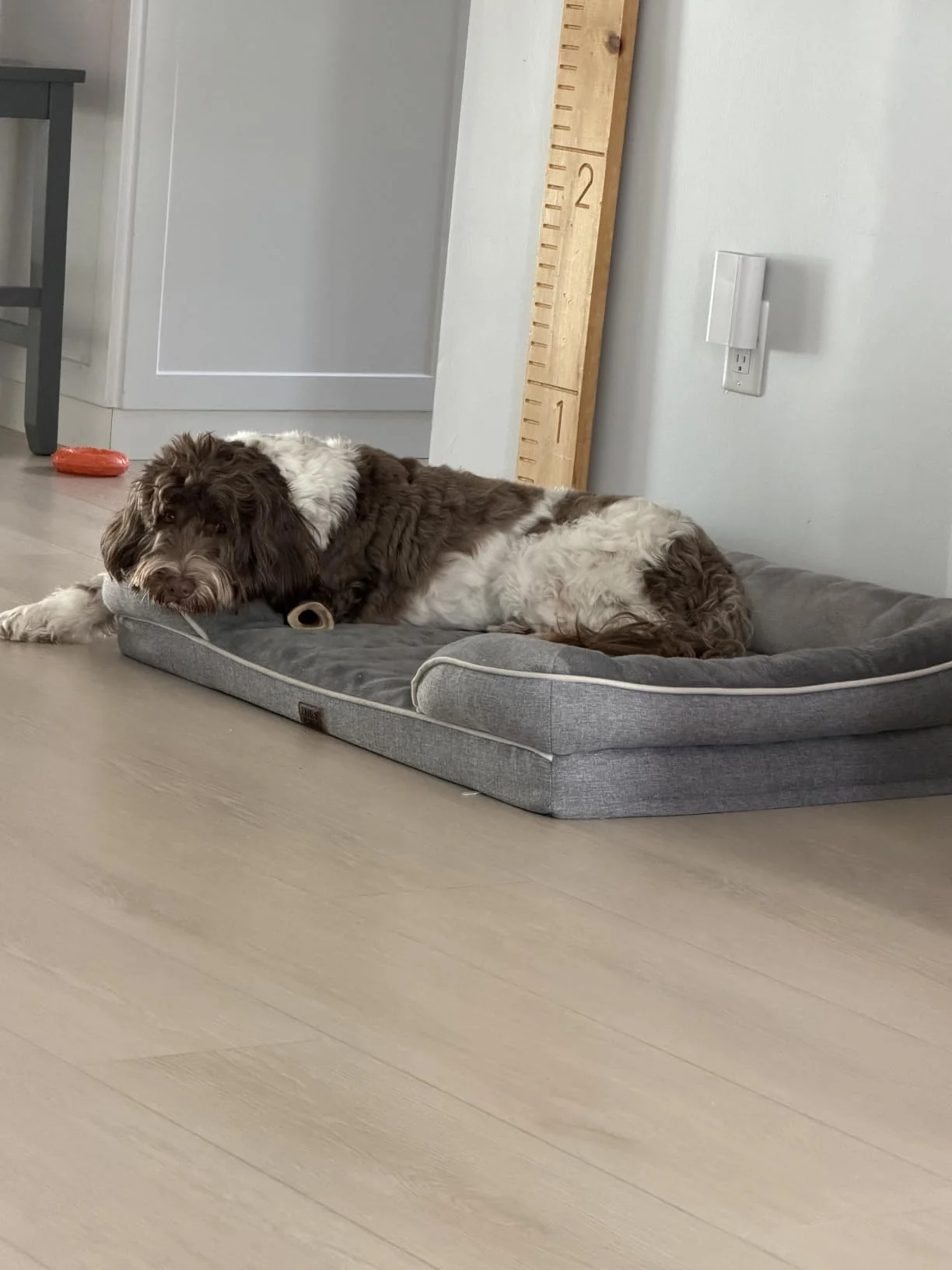
🖐 Press the Middle Before Your Dog Does
Place both hands in the center of the bed and press down firmly.
If your palms almost reach the floor with moderate pressure—or the foam barely rebounds after you let go—that cushion may struggle even more once a large dog lies on it for several hours. A bed that feels supportive for a person leaning briefly is very different from supporting a heavy dog throughout the night.
Veterinary research has shown that denser support materials recover their shape more effectively under repeated pressure, while studies on dogs with joint disease have also linked uncomfortable resting surfaces with disrupted nighttime rest and increased discomfort. The goal isn't simply softness—it's maintaining enough support after the dog's full weight settles in.
A flattened bed doesn't automatically mean every product in the category performs the same way. However, when a mattress marketed for large breeds never reaches its advertised height, it's reasonable to question whether it can deliver the level of support many senior or heavyweight dogs are expected to receive.
How Bed Firmness Affects Standing Up for Dogs with Mobility Loss
For many senior dogs, lying down isn't the hardest part of the day.
If the foam collapses under their weight, there is nothing solid to push against. Instead of one smooth movement, the front legs brace, the back legs search for traction, and the dog may rock forward two or three times before finally standing.
That struggle showed up repeatedly in PGH-AUDIT-DQBB, where owners of dogs living with IVDD or hip problems described how supportive beds became an important part of everyday comfort. Similar experiences also appeared in PGH-AUDIT-2HJZ, where large senior dogs needed a sleeping surface that stayed firm instead of compressing flat beneath them.
The issue goes beyond comfort.
When a bed sinks too deeply, the dog's body has to climb out of its own sleeping spot before it can even begin standing. Every failed push shifts extra effort onto already sensitive hips, knees, and shoulders. For dogs with reduced mobility, that repeated struggle can become part of every nap.
Veterinary guidance for dogs recovering from orthopedic procedures emphasizes the value of stable sleeping surfaces and supportive edges, making it easier for dogs to transition from lying down to standing without excessive strain. A bed isn't simply a place to rest—it can also become the first step in every movement the dog makes after waking.
🐾 Watch the First Push-Up
The next time your dog gets up after a long nap, don't watch the whole body first.
Watch the front paws.
If they slide forward while the chest stays buried in the cushion, or your dog needs several attempts before gaining enough leverage to stand, the bed may be absorbing the force that should have been helping the dog rise. The same warning sign appears if the foam stays compressed for several seconds after your dog walks away.
That doesn't automatically mean every soft bed is unsuitable, and mobility problems can have many causes. Still, when a bed marketed for orthopedic support offers little resistance under a heavy or aging dog, it's worth taking a closer look before assuming the difficulty comes only from age.
What Happens When a Bolster Insert Is 7 Inches Too Long for Its Cover
A bolster bed only works when every piece fits together.
Once the insert is longer than the cover, the entire sleeping surface starts fighting against itself. Instead of forming a supportive edge, the side bolster twists, bunches up, or pushes the base foam out of position.
That is exactly what owners described in PGH-AUDIT-79N7, where a U-shaped bolster insert extended roughly seven inches beyond the cover, making assembly difficult and leaving the finished bed visibly distorted. Similar complaints appeared in PGH-AUDIT-WTVB, where uneven filling and shifting materials left parts of the bed flatter than others after regular use.
The biggest problem isn't how the bed looks.
When shredded foam gathers into clumps inside the bolster while other sections become nearly empty, the edge loses its ability to support the dog's head and neck. One side may feel firm while another collapses, causing the neck to rest at an awkward angle or slide into a hollow instead of being gently supported.
🛏️ Zip It Closed Before You Trust It
Before your dog starts using a new bolster bed, zip the cover completely and run both hands around the entire U-shaped edge.
If you can feel hard lumps in one section, loose empty pockets in another, or fabric stretched tight at one end but wrinkled at the other, the insert and cover may not be properly matched. Try pressing several spots around the bolster. The resistance should feel reasonably even instead of changing dramatically every few inches.
These reports don't mean every bolster bed is built this way. However, when the insert and cover clearly don't match from the beginning, it's reasonable to expect the sleeping surface to become even more uneven with continued daily use, especially if the bolster relies on loose shredded filling rather than maintaining a consistent shape.
Vacuum-Sealed Foam That Fails to Decompress After 48 Hours
Opening a vacuum-packed dog bed should be the beginning of the setup—not the end of it.
Some beds gradually regain their shape over the next day or two. Others never do. Instead, a deep crease remains where the bed was folded for shipping, leaving a permanent valley across the middle of the sleeping surface.
One example came from PGH-AUDIT-ZCTY, where owners described a bed that arrived folded so tightly that the center seam never recovered, even after waiting through the recommended expansion period. Similar reports from PGH-AUDIT-79N7 described foam that stayed compressed instead of fully inflating, leaving parts of the bed noticeably lower than others.
The result isn't just cosmetic.
When the center sinks below the surrounding surface, larger dogs naturally settle into the lowest point. Rather than resting on one continuous cushion, their shoulders, hips, and spine end up bridging across an uneven surface that was supposed to provide even support.
Veterinary research has shown that foam permanently damaged by prolonged compression can lose much of its ability to rebound under repeated loading. Once the internal structure no longer recovers properly, waiting another day—or another week—rarely restores the original sleeping surface.
📦 Unfold It and Sight Across the Surface
Before throwing away the packaging, step back and look across the bed from one end instead of directly above it.
A healthy foam base should appear consistently level after it has had adequate time to expand. If a long trench still runs through the middle, one side sits lower than the other, or the fold line remains easy to spot when viewed from eye level, the foam may not have recovered from shipping.
That doesn't mean every vacuum-packed bed will develop a permanent crease. Many expand exactly as intended. But when a deep center groove remains well after the recommended recovery period, current user reports suggest it's worth questioning whether that sleeping surface will ever provide the flat support originally advertised.
Actual Sleeping Surface Differences Between Large and Extra-Large Beds
Many shoppers assume an XL dog bed automatically provides a larger sleeping area than a Large model. In practice, that isn't always true.
One recurring issue is that the advertised outside dimensions include thick side bolsters, while the usable center cushion is much smaller. Reports associated with PGH-AUDIT-WTVB described beds sold as "Large" that felt closer to a medium-size sleeping area once assembled. Similar sizing concerns also appeared in PGH-AUDIT-79N7, where oversized bolsters reduced the open space available for the dog to actually lie on.
For giant breeds, the difference matters more than a few inches on a product label.
A dog that cannot stretch its front legs forward or extend its hind legs naturally often ends up sleeping curled against the bolsters instead of resting across the center cushion. As the side supports become thicker, the advertised footprint may increase while the usable sleeping platform changes very little.
Behavioral research has also found that dogs prefer comfortable resting surfaces that allow natural lying positions rather than unnecessarily restricted spaces. A generous outer size does not automatically translate into a generous sleeping surface if a large portion of that footprint is occupied by raised edges.
When comparing beds for large breeds, focus on the inside sleeping dimensions after subtracting the bolsters, not simply the overall width and length printed on the box. That measurement provides a much more realistic indication of whether a Labrador, Rottweiler, Great Dane, or other large dog will be able to lie flat, roll over comfortably, and fully stretch without resting against the side cushions.
CONCLUSION
A dog bed should be judged by how it performs after regular use rather than how impressive it looks in the packaging. Supportive foam should continue holding its shape, the sleeping surface should remain level, and the usable space should match your dog's size instead of relying on generous outside measurements. Before committing to a purchase, it helps to look beyond advertised thickness and overall dimensions. Check whether the foam rebounds well, whether the bolsters stay evenly filled, and whether the center cushion provides enough room for natural sleeping positions. Taking a few minutes to evaluate these practical details can help avoid disappointment later and improve the chances of choosing a bed that continues providing reliable comfort as your dog grows older or spends more time resting.
THE ULTIMATE BUYING VERDICT
| Verdict | Key Consideration | Recommendation |
|---|---|---|
| 🔴 Significant concerns | Products that fail basic durability checks, flatten easily under pressure, or lack full perimeter water protection. | These products may require extra scrutiny when used by heavy or aging pets. |
| 🟡 Acceptable with limitations | Products that perform adequately but show compromises in materials, heat management, or long-term durability. | Suitable for lighter use when owners understand the expected trade-offs. |
| 🟢 Meets long-term expectations | Products built with supportive materials, full perimeter protection, and stable construction. | These characteristics generally provide the most reliable long-term comfort and durability. |